Every injectable batch you release carries a USP <788> result. For most quality teams, that result is a line on the certificate of analysis: pass, fail, move on. But on August 1, 2026, the chapter behind that line changed. It has a new title and a broader scope, and it gives you more room in how you test. The questions auditors ask about your particulate data are changing with it.
This guide covers what <788> requires, how the two test methods differ, what the 2026 revision changed, and where we see particulate programs run into trouble. It is written for QA managers who own the result but don’t run the instrument every day.
What does USP <788> actually measure?
USP <788>, now titled Subvisible Particulate Matter in Injections, sets limits on the particles in injectable products that are too small to see but large enough to matter. The chapter defines particulate matter as mobile, undissolved particles, other than gas bubbles, that are unintentionally present in the product.
Counts are reported at two size thresholds: ≥10 µm and ≥25 µm. Particles in this range can come from almost anywhere: glass delamination, elastomeric closures, silicone oil, filling equipment, single-use components, fibers from gowning, or the product itself. The clinical concerns are real. Subvisible particles can occlude small blood vessels, and for biologics they are linked to immunogenicity risk.
It helps to know where <788> sits among the other particulate chapters:
- USP <790> covers visible particulates and requires 100% inspection of every unit.
- USP <1790> is the guidance chapter behind visual inspection programs.
- USP <788> is the quantitative, sampled test for the subvisible range.
- USP <1788> is the informational chapter that explains how to run the <788> methods correctly.
A good program treats these as one system rather than four separate compliance boxes. A rising subvisible count is often the first sign of the visible particle you will be investigating months later.
Method 1 vs. Method 2: which test applies to your product?
USP <788> gives you two methods. Method 1, the light obscuration particle count test, is the preferred approach. Method 2, the microscopic particle count test, is used when light obscuration can’t give a reliable answer.
Light obscuration (LO) draws the sample through a sensor. Each particle blocks part of a light beam, and the instrument sizes the particle by how much light it blocks. It is fast, automated, and reproducible, which is why it is the default.
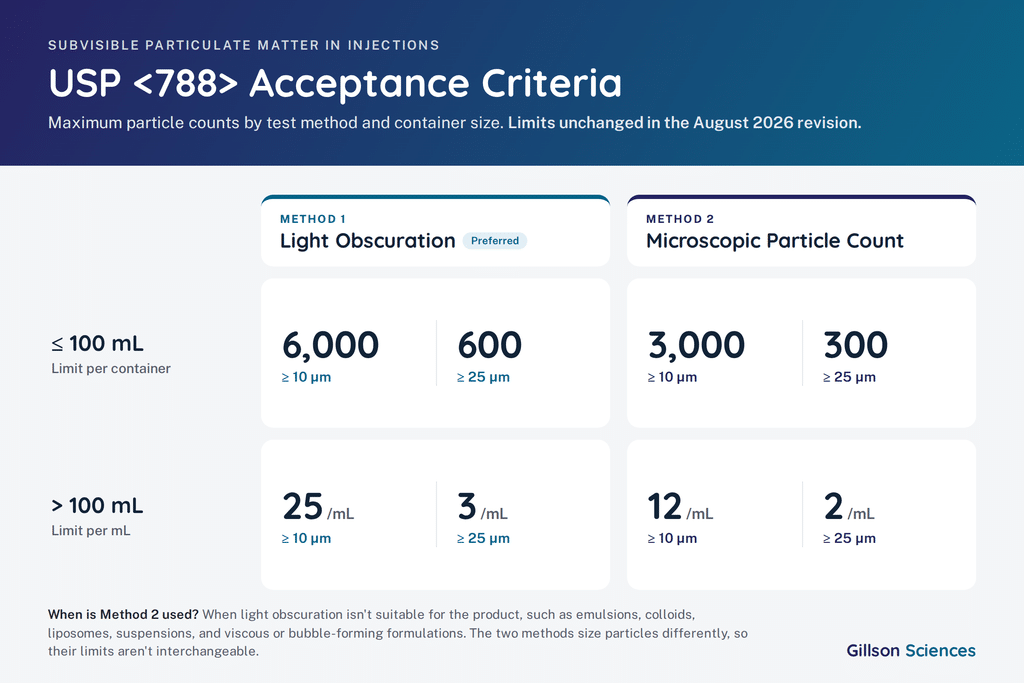
The USP 788 acceptance criteria look like this:
Microscopic particle counting filters the sample through a membrane. An analyst then counts and sizes the retained particles under a microscope using a calibrated graticule. It takes more time and more skill, but it works on products that LO handles poorly.
Method 2 limits are lower, but that doesn’t make it the “stricter” test. The two techniques size particles differently, so their numbers can’t be swapped for each other.
When is Method 2 required? Products with reduced clarity or higher viscosity are the usual cases: emulsions, colloids, liposomal formulations, suspensions, and products that form air or gas bubbles as they pass through the sensor. The chapter also expects that some products will need LO followed by microscopic counting before you can conclude whether they conform. If you don’t yet know which case your product falls into, find out during method feasibility, not during an out-of-specification (OOS) investigation.
What changed in the August 2026 revision?
The revised chapter became official on August 1, 2026. It completes harmonization with European Pharmacopoeia 2.9.19 and Japanese Pharmacopoeia 6.07 through the Pharmacopoeial Discussion Group. The key changes for QA teams:
- New title and sharper focus. The chapter is now Subvisible Particulate Matter in Injections, which makes clear its job is the subvisible range. Visible particles stay under <790>.
- Explicit scope for IM and SC products. Intramuscular and subcutaneous injectables are now clearly within scope. That matters for the growing number of prefilled syringes and autoinjectors.
- More flexibility on test units and sample volumes. You now have more latitude in the number of units and volumes tested, provided the plan is scientifically justified. This helps most with low-fill and high-value biologics, where the traditional pooled 25 mL volume was hard to reach.
- Alternative diluents when justified.
- Same limits, same methods. The numerical limits and the two test methods did not change.
USP has also moved on the related chapters. It has proposed omitting <787> (the protein-specific subvisible chapter) now that the harmonized <788> covers therapeutic protein injections. It has also expanded <1788>, which now carries a dedicated section on flow imaging microscopy, <1788.3>.
The practical takeaway: the new flexibility isn’t a free pass. It moves the burden onto your justification. If you test fewer units, smaller aliquots, or a different diluent, you need a documented scientific rationale that will hold up in an inspection. Now is also a good time to confirm that your specifications, test methods, and CoAs cite the current version of the chapter.
Where flow imaging fits
Light obscuration tells you how many particles passed the sensor and roughly how large they were. It does not tell you what they were. That gap is why flow imaging microscopy has moved from a research technique to a standard part of a mature subvisible program, and why USP gave it its own section, <1788.3>, in the informational chapter that supports <788>.
Flow imaging photographs each particle as it flows past a camera, in liquid, so fragile structures keep their shape. Every particle produces an image, which means you get morphology alongside size and count: shape, aspect ratio, transparency. That is what separates a round silicone oil droplet from an irregular protein aggregate, two populations that light obscuration reports as a single number. Flow imaging also reaches below the compendial thresholds. Most instruments size from roughly 2 µm, and for protein products a large share of the particle population sits under the ≥10 µm reporting threshold, which is often where instability shows up first.
Two points matter for QA. First, flow imaging is not a compendial release test. It does not replace or override a <788> result, and a product that fails light obscuration does not pass because the images look benign. Second, that is exactly why it is useful. Its place is in method feasibility, formulation and container-closure development, stability studies, trending, and OOS investigations, where the question is not how many but what are they, and where did they come from.
Expect this to grow. With <787> proposed for omission and <1788> expanding around techniques like flow imaging, USP’s direction is clear: particle counts alone are no longer a complete picture of a subvisible program.
Where do USP <788> programs go wrong?
In our experience working with sterile manufacturers, <788> problems rarely come from the limits themselves. They come from what happens around the test.
Sample preparation artifacts. Air bubbles, poor degassing, inconsistent pooling, and unclean glassware all show up as particles. The chapter builds in a check: for light obscuration, if a 25 mL blank of particle-free water contains more than 25 particles at ≥10 µm, the test environment isn’t clean enough. A lab that routinely struggles with blanks will struggle with your data.
Using the wrong method for the formulation. Light obscuration can count silicone oil droplets as particles. It can also undercount translucent protein aggregates, whose refractive index is close to the surrounding liquid. For biologics and prefilled syringes, pairing the compendial test with flow imaging is the difference between a number and an explanation.
Treating an OOS as a counting problem. A count tells you how many particles you have. It doesn’t tell you what they are or where they came from. Without particle identification and material characterization, and ideally a facility particle library to compare against, root cause investigations turn into weeks of guesswork.
Looking only at pass/fail. A batch at 4,800 particles per container passes. So does a batch at 400. If your program doesn’t trend those numbers, you are missing the most useful information <788> gives you. We made the case for this in Stop Treating Subvisible Particles as a Release Test.
Weak instrument qualification. <1788> expects LO systems to be calibrated with certified reference particles, and sensor resolution, counting accuracy, and sample volume accuracy all need to be verified. Gaps in this paperwork are an easy audit finding and a hard one to defend.
What Gillson Recommends
For QA managers who want a <788> program that holds up in an inspection and helps their operations:
- Confirm method fit before you validate. Run feasibility work to decide whether light obscuration, microscopic counting, or both are right for each product. Pay particular attention to emulsions, suspensions, proteins, and silicone-lubricated containers.
- Document your justification for the revision’s flexibility. If you reduce units, volumes, or change diluents under the revised chapter, write the scientific rationale into the method before an auditor asks for it.
- Trend the data, not just the result. Set internal alert levels well below the compendial limits so you catch process drift before it becomes an OOS.
- Pair counting with identification. Make sure your lab, or your partner’s lab, can move straight from an elevated count to flow imaging and to FTIR, Raman, or SEM-EDX identification.
- Add an orthogonal method for protein products. For biologics, prefilled syringes and silicone-lubricated containers, build flow imaging into development and stability work rather than waiting for an OOS to justify it.
- Audit your paper trail. Check that specifications, methods, and CoAs reference the current chapter, and that instrument calibration records meet <1788> expectations.
The Bottom Line
USP <788> is one of the most routine tests in parenteral quality control, which is exactly why it gets taken for granted. The August 2026 revision didn’t move the limits, but it did move responsibility onto manufacturers to justify how they test. The programs that do well will be the ones that treat subvisible particle data as process intelligence, not a checkbox on the CoA.
Gillson Sciences performs USP <788> particulate matter testing by light obscuration and microscopic particle counting. We support the full lifecycle: feasibility, method development, validation, transfer, and routine release. We also offer orthogonal flow imaging, particle identification, and visual inspection support. If your team is reviewing its particulate program against the revised chapter, we’re glad to help.
Frequently Asked Questions
What are the USP <788> limits? For light obscuration, containers of 100 mL or less must have no more than 6,000 particles ≥10 µm and 600 particles ≥25 µm per container. Containers over 100 mL must have no more than 25 particles/mL ≥10 µm and 3 particles/mL ≥25 µm. The microscopic method has lower limits: 3,000 and 300 per container, or 12 and 2 per mL.
When is the USP <788> microscopic method used? When light obscuration can’t give a reliable result. Common cases are emulsions, colloids, liposomes, suspensions, viscous products, and products that form bubbles in the sensor.
What changed in USP <788> in 2026? The revision became official on August 1, 2026. It retitled the chapter Subvisible Particulate Matter in Injections, harmonized it with Ph. Eur. 2.9.19 and JP 6.07, and explicitly included IM and SC products. It also allows justified flexibility in test units, sample volumes, and diluents. The limits and methods did not change.